Taoiseach Summons 1916 to Bury It
News
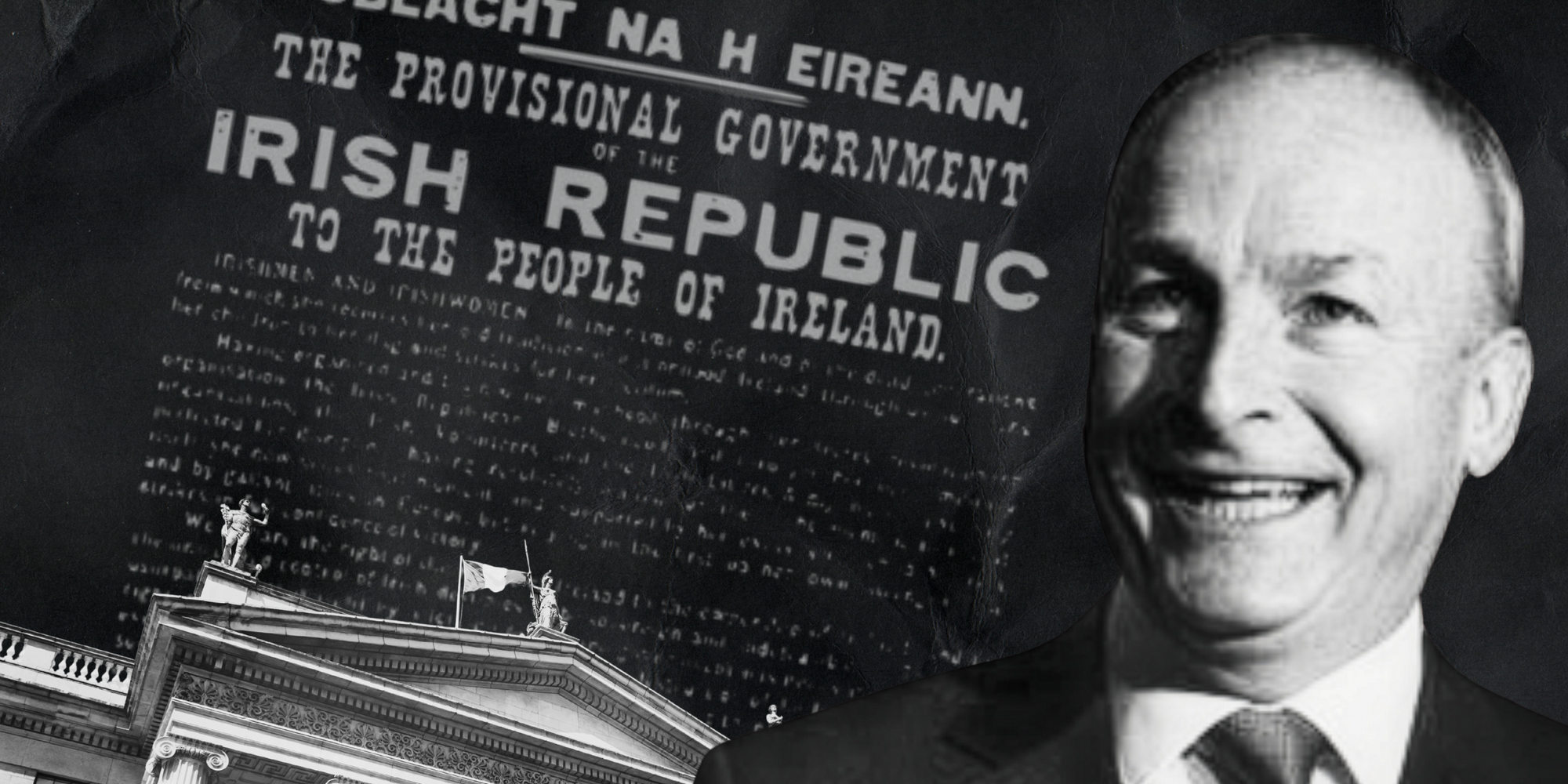
Speaking at a Fianna Fáil and Europe seminar in Cork at the weekend, Taoiseach Micheál Martin said that nationalists in other countries had “wanted to restore some sense of national superiority or uniqueness,” and that this was “the exact opposite of the republicanism of Theobald Wolfe Tone, the nationalism of Daniel O’Connell and the vision of the Proclamation of 1916.”
He praised Éamon de Valera’s “values-based internationalism” and the reforms of Jack Lynch’s governments between 1966 and 1973. Lynch, he said, “had the vision to see beyond a narrow ‘little Irelander, ourselves alone’ ideology,” knowing that Irish self-determination “has always been about taking our place among the nations, not standing separate from them.”
The speech, barely a few days old, acted as a rhetorical primer and justification of the Taoiseach’s main legislative goal. As of the evening of 21 October 2026, the Dáil voted 79–71 to pass the Second Stage of the Defence (Amendment) Bill 2026. The bill, which would remove the UN element of the triple lock, now proceeds to Committee Stage.
Commentary
Martin’s proclivity for subverting the Irish national tradition in his political speeches is, by now, a well-established character trait. In April of last year, he attempted a recasting of the Proclamation as inclusive and internationalist, declaring: “We don’t believe in a narrow nationalism.” April of this year found the Taoiseach describing the 1916 leaders as “deeply modern and outward-looking – even in their cultural nationalism”—that “even” being the tell-tale condescension to those who would dare to value Irish culture on its own terms. It seems that at every opportunity, the Taoiseach exults in summoning the revolutionary dead to endorse the values of the “modern Ireland” that the FF/FG duopoly has been so busily building. The pattern has become a liturgy of its own, and a tedious one at that.
But what else could be expected from a man who has said that his first encounter with James Joyce in college relieved him of any residual nationalism? What strange animus moves a man to declare that Ireland will have nothing to do with a “backward-looking idea of sovereignty,” or that the Irish “never were a homogeneous group”? The subtextual target, of course, is the nebulous “far right,” the favoured bogeyman of haughty liberal functionaries like Martin—though he now seems to have expanded his vocabulary of reproach with “little Irelander,” an imported Britishism.
In truth, the “far right” that apparently haunts Martin’s nightmares, and for which he probably checks under his bed every night, is what amounts to, functionally, the segment of the Irish populace which dares to hold values and principles held by their grandparents and myriad generations before that still. They are the true bearers of the national tradition, and they have not shifted dramatically at all. What has shifted dramatically—radically, in the full revolutionary connotation of that term—is the values of the governing elite of this country; namely, the espoused ideology of Tweedledum and Tweedledee—excuse me, FF and FG.
The Proclamation itself refutes the Taoiseach’s platitudes. Its very opening summons Irishmen and Irishwomen “in the name of God and of the dead generations from which she receives her old tradition of nationhood.” An old tradition of nationhood is, of course, by definition, a claim to be distinct. Pearse wanted an Ireland “not free merely, but Gaelic as well.” Men do not give their lives for a nation they believe to be interchangeable with any other. A forward-looking Irish modernism was indeed a real thing. So too was solidarity with other European nations. Both were, however, downstream of the foundational goal of ethno-cultural survival and sovereignty. Summoning the ghosts of 1916 to attack nationalism’s inherent ties with “uniqueness” is as perverse as it is wrong.
Martin would have us repurpose the 18th century, and believe that the solidarity Wolfe Tone preached, which sought to bind Protestant, Catholic and Dissenter into a formidable political force that, with the military aid of its French ally, would take on England, the implacable enemy of Irish freedom, is somehow equivalent to the modern milk-toast liberalised meaning of the term. Tone was not, in fact, in favour of the current Irish government’s modus operandi of an inexplicable, unilateral solidarity with the denizens of the third world and their supposed concomitant right to relocate to Ireland (shocking, I know…).
When Tone offered solidarity, it was solidarity between nations intent on preserving themselves. When he looked to revolutionary France, it was to break the connection with England, “the never failing source of all our political evils,” not to trade one distant capital for another.
But add all of these revisionist insults to the inconsistencies of his recent address, and you find a man that even the most supine FF backbencher is ripe for toppling. The Taoiseach’s latest Cork speech also undoes itself on its own terms. Martin praised Lynch for seeing beyond a “narrow ‘little Irelander, ourselves alone’ ideology”; yet “ourselves alone” is the very meaning of Sinn Féin, the de Valera-led political forebear to Fianna Fáil which he would found in 1926. The Taoiseach, in other words, is disowning his own party’s lineage. His praise for de Valera’s internationalism was quickly followed by the full approval of Fianna Fáil’s declaration that joining the EEC marked “the formal end of neutrality”, the very neutrality de Valera held to through the Second World War, which is not very congruent with neutrality being a core element of his internationalism. Even Martin’s flourish that self-determination means “taking our place among the nations” falls flat. Invoking Robert Emmet doesn’t exactly work when the man who asked that his epitaph not be written until Ireland took “her place among the nations of the earth” meant a place of Ireland’s own, not merely a seat at someone else’s table.
In the context of the dismantling of the triple lock, it is clear why he feels the need to recast Ireland’s longstanding notions of sovereignty. Martin has been front and centre of the push to remove the UN authorisation element, and fundamentally alter one of the core elements of Irish neutrality. Public opinion remains overwhelmingly in favour of maintaining the current model, and it was central to reassuring voters during the Nice and Lisbon referendums as a neutrality guarantee which would prevent Ireland being dragged into EU conflicts. Since it was linked to previous referendums, much of the Irish public feels hoodwinked at the FF/FG push for removing the triple lock when it was not a prominent issue of their campaign or manifesto. Much of the oratory shenanigans make sense in light of that.
Martin may equivocate superiority and uniqueness, and neutrality with isolated “little Irelanders” in a sleight of hand that repurposes nationalist figures for his own aims, but they are not the same, and one does not imply the other. Irish ethnic identity can be cherished, and measures taken to protect it, without any claim to superiority over other peoples. The same is true of Irish culture. Our neutrality has been a longstanding expression of our sovereignty, not a creed of isolation and inwardness. The Taoiseach can abuse the nationalist pantheon all he likes, but these simple truths will never change.